
Compound Interest Calculator — See How Fast Your Money Can Grow
Free Online Finance Calculator
Use the calculator
Calculate Your Compound Interest — Free & Instant
Our compound interest calculator gives you instant, accurate results for any investment or savings goal. Simply enter your starting amount, annual interest rate, compounding frequency, and time period — and the calculator will show you your final balance, total interest earned, and year-by-year growth. Whether you are planning for retirement, tracking crypto staking rewards, or calculating how debt compounds against you — this tool has you covered.
ZorvoTools · A = P(1 + r/n)^(nt) · Results for informational purposes only
Try the Compound Interest Calculator
<!-- ZorvoTools Compound Interest Calculator Embed --><iframe src="https://zorvotools.com/
compound-interest-calculator/" width="100%" height="650" style="border:none; border-radius:12px; max-width:680px; display:block; margin:0 auto;" title="Free Compound Interest Calculator — ZorvoTools" loading="lazy" allowfullscreen></iframe><p style="text-align:center; font-size:13px; margin-top:8px;"> Powered by <a href="https://zorvotools.com" target="_blank" rel="dofollow">ZorvoTools — Free Online Calculator Tools</a></p> How to Use
How to Use the Compound Interest Calculator — 3 Simple Steps
Using ZorvoTools’ compound interest calculator takes less than 30 seconds. There are no complicated forms, no hidden fields, and no signup required. Follow these three steps to calculate exactly how your money will grow — whether you are investing in a US 401(k), a UK ISA, or any savings account worldwide.
Enter Your Values
Enter your starting principal amount (the money you are investing today), your annual interest rate, your chosen compounding frequency (daily gives slightly higher returns than monthly or annually), and the number of years you plan to invest. Optionally, add a monthly contribution if you plan to invest regularly.
Click Calculate
Hit the blue Calculate button. The calculator instantly runs the compound interest formula — A = P(1 + r/n)^(nt) — and displays your results in a clean, easy-to-read breakdown showing your final balance, total interest earned, and contribution breakdown.
Download Your Results as a PDF
Once your results appear, click the “Download Your Result as a PDF” button to save a clean, professionally formatted report — completely free. Share it with your financial advisor or keep it for your records.

Result Explanation
Understanding Your Compound Interest Results
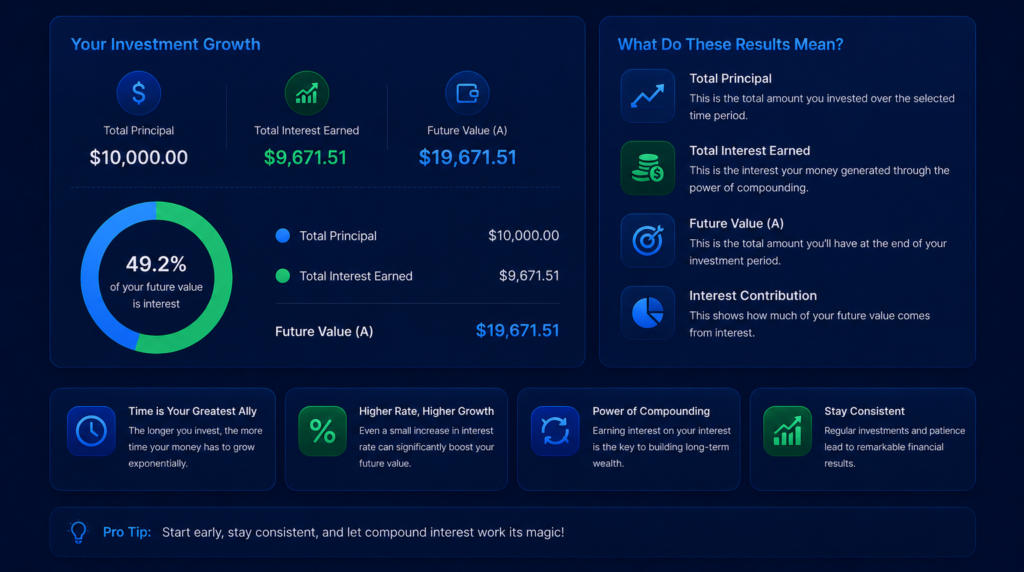
Once you calculate, you will see three key numbers: your Final Balance (the total value of your investment at the end of the period), Total Interest Earned (how much your money grew), and Total Contributions (how much you personally put in). The difference between your contributions and final balance is the power of compounding at work.
WHAT YOUR RESULTS MEAN:
Final Balance
This is the total amount you will have at the end of your investment period, including your original principal, all contributions, and all compounded interest. This is the number you are building toward.
Total Interest Earned
US EXAMPLE:
$10,000 invested at 7% annual return (S&P 500 average), compounded monthly for 30 years = Final Balance of $81,745. Your money grew 8x without any additional contributions.
UK EXAMPLE:
£10,000 in a Cash ISA at 4.5% AER (2025 rate), compounded monthly for 20 years = Final Balance of £24,117. Over £14,000 earned in interest — completely tax-free inside an ISA wrapper.
Interest saved vs interest saved on debt:
For debt (credit cards, loans), compound interest works against you. A $5,000 credit card balance at 24% APR compounded monthly becomes $9,774 in just 3 years if left unpaid. Use our compound interest calculator for debt to see exactly how quickly balances grow — and motivate faster payoff.
Formula / Method
The Compound Interest Formula Explained Simply
Our calculator uses the universally accepted compound interest formula, the same formula used by the US SEC (Securities and Exchange Commission) and UK FCA (Financial Conduct Authority) in their official financial education resources. Here is the formula broken down so you can understand exactly what the calculator is doing with your numbers.
Scenario
Formula
What It Tells You
Standard compound interest
A = P(1 + r/n)^(nt)
Final balance after compounding over any time period
Compound interest with monthly contributions
A = P(1+r/n)^(nt) + PMT × [((1+r/n)^(nt) − 1) / (r/n)]
Final balance when you add money regularly each month
Daily compounding (crypto staking / HYSA)
A = P(1 + r/365)^(365t)
Maximum compounding effect — used for crypto staking rewards
Compound interest on debt (credit cards)
A = P(1 + APR/12)^(12t)
How fast unpaid debt grows when left compounding monthly
FIRE target calculation
FIRE Number = Annual Expenses × 25
Portfolio size needed to retire using the 4% withdrawal rule
Rule of 72 (years to double)
Years to Double = 72 ÷ Annual Rate (%)
Quick mental math to compare investment options
Effective Annual Rate (EAR / AER)
EAR = (1 + r/n)^n − 1
True yearly return after compounding — used in UK AER comparisons
Daily compounding earns $1,127 more than annual compounding on the same investment.
Who Uses This Calculator?
Why Compound Interest Is the Most Powerful Force in Personal Finance
WHAT IS COMPOUND INTEREST?
Here is a side-by-side example that makes this clear:
$10,000 at 7% for 30 years: Simple Interest: $10,000 + ($700 × 30) = $31,000 Compound Interest: $10,000 × (1.07)^30 = $76,123 The difference: $45,123 — just from reinvesting interest.
COMPOUND INTEREST FOR DIFFERENT GOALS
Retirement Savings (US 401k & UK ISA)
For US investors, the S&P 500 has historically returned an average of 7-10% annually after inflation adjustment. A $200/month contribution starting at age 25, compounded monthly at 8%, results in $702,856 by age 65. Wait until age 35 to start, and that number drops to $298,071 — a $400,000 penalty for waiting 10 years.
For UK investors, the current best Cash ISA rates sit at 4.5-5% AER (2025). Tax-free compounding inside an ISA wrapper means every penny of interest works for you without HMRC taking a cut. Use our compound interest calculator to model your ISA growth year by year.
FIRE Movement (Financial Independence, Retire Early)
The FIRE compound interest calculator approach is simple: calculate how large your investment portfolio needs to be to support your annual expenses indefinitely. The 4% withdrawal rule — used by most FIRE communities — means you need 25x your annual expenses invested. Our calculator lets you work backwards: enter your FIRE target as the final balance and calculate how long it takes to reach it.
Compound Interest for Crypto Staking
Crypto staking rewards work exactly like compound interest — except with much higher (and more volatile) rates. If you stake $5,000 at a 12% annual staking reward and reinvest (restake) rewards daily, you end up with $6,726 after one year. Our calculator supports daily compounding, making it ideal for modeling crypto staking compound interest scenarios. Note: crypto returns are not guaranteed — use conservative estimates.
Biweekly vs Monthly Compounding
Many US mortgages and loans offer biweekly payment options. While our calculator models daily through annual compounding, the principle is clear: the more frequently interest compounds — or the more frequently you make payments — the bigger the difference over time. A $300,000 mortgage at 7% over 30 years costs $419,306 in interest with monthly payments. With biweekly payments, you save approximately $46,000 and pay off 4 years earlier.
Compound Interest for Startup Equity
Startup founders and early investors can use compound interest logic to model equity growth. If a startup is valued at $2M today and grows at 40% annually (a typical early-stage VC target), a $50,000 investment compounds to $1.35M in 10 years — assuming no dilution. Use our calculator to model these projections and compare against traditional investment returns.
HOW COMPOUNDING FREQUENCY AFFECTS YOUR WEALTH
The frequency at which interest compounds has a real — though often underestimated — impact on your final wealth. Daily compounding slightly outperforms monthly, which outperforms quarterly, which outperforms annual. For most savings accounts and investments, monthly compounding is the standard. However, for high-rate environments (crypto staking, high-yield savings), daily compounding can make a meaningful difference.
WHY USE ZORVOTOOLS COMPOUND INTEREST CALCULATOR?
- Completely free — no signup, no paywalls, ever
- Supports Daily, Monthly, Quarterly, and Annual compounding
- Optional monthly contribution input for realistic savings modeling
- Download results as a clean PDF report — free
- Dark mode UI designed for fast performance on any device
- Works perfectly on mobile, tablet, and desktop
- Results in under 2 seconds
- Designed for US, UK, Canadian, and Australian users with local context
Whether you are planning your retirement, modeling FIRE scenarios, calculating crypto staking compound interest, or trying to understand how debt compounds against you — ZorvoTools gives you the clearest picture in the fewest clicks.

FAQ
Frequently Asked Questions
Got questions about how compound interest works? You are not alone. Here are the most searched questions — answered in plain English, with real US and UK examples.
What is the compound interest formula?
A = P(1 + r/n)^(nt). Where P = principal, r = annual rate (decimal), n = compounding periods per year, t = years. Our calculator runs this formula instantly for you.
How often does compound interest compound?
Daily (365×/year), Monthly (12×), Quarterly (4×), or Annually (1×). Most US and UK savings accounts compound monthly. Daily compounding generates slightly higher returns over long periods.
What is the difference between simple and compound interest?
Simple interest is calculated on your principal only. Compound interest earns returns on your principal plus all previously earned interest — creating the “snowball effect” that makes long-term investing so powerful.
Can I use this as a compound interest calculator for crypto staking?
Yes. Enter your staking APY as the interest rate and select daily compounding. This models restaking rewards accurately. Remember: crypto returns are not guaranteed — always use conservative estimates.
What is the FIRE compound interest strategy?
FIRE (Financial Independence, Retire Early) requires building a portfolio equal to 25x your annual expenses. Use our calculator to model how long different contribution amounts and return rates take to reach your FIRE target.
How does compound interest work on debt?
Against you, fast. A $3,000 credit card balance at 24% APR compounded daily becomes $5,864 in 3 years without payments. Use the calculator with your balance as the principal to see your debt timeline.
What is the difference between biweekly vs monthly interest?
Biweekly compounds 26 times per year vs monthly at 12 times. For mortgage holders, switching to biweekly payments makes one extra annual payment — saving $30,000-$50,000 in interest on a typical 30-year US mortgage.
What is the Rule of 72?
Divide 72 by your interest rate to find years to double your money. At 6%: 12 years. At 9%: 8 years. At 12%: 6 years. Quick mental math for comparing investment options.
Is compound interest tax-free in the UK?
Inside a Cash ISA or Stocks & Shares ISA — yes, completely tax-free. Outside an ISA, interest above your Personal Savings Allowance (£500-£1,000 depending on tax band) is subject to Income Tax.
Can I download my results as a PDF?
Yes — 100% free. After calculating, click “Download Your Result as a PDF” to save a professionally formatted report. No signup required.
Important Disclaimer
The ZorvoTools Compound Interest Calculator is provided for informational and educational purposes only. Results are mathematical estimates based on fixed interest rates and regular contributions. Actual investment returns vary due to market conditions, fees, taxes, and other factors. This tool does not constitute financial advice. Always consult a qualified financial advisor before making investment decisions. For regulated financial products in the US, visit SEC.gov. For UK financial guidance, visit FCA.org.uk. Read our full Disclaimer here Disclaimer Policy