
Present Value (PV) Calculator
Free Online Finance Calculator
Use the calculator
Calculate Present Value Instantly
Enter your future value, discount rate, and number of periods into the Present Value (PV) Calculator below, and it will instantly show you how much that future amount is worth today — no manual formulas, no spreadsheets required.
| Year | Invested | Interest | Balance |
|---|
Results are estimates for educational purposes only and are not financial advice. Actual investment returns, taxes, inflation and fees can vary.
Try the Present Value Calculator
<iframe
src=”https://zorvotools.com/pr
width=”100%”
height=”620″
style=”border:1px solid #e2e2e2; border-radius:12px; max-width:600px;”
loading=”lazy”
title=”Present Value (PV) Calculator by Zorvo Tools”>
</iframe>
<p style=”font-size:12px; color:#777; margin-top:6px;”>
Powered by the free
<a href=”https://zorvotools.com/p
Present Value (PV) Calculator
</a>
from Zorvo Tools.
</p>
</div>
How to Use
How to Use the Present Value (PV) Calculator
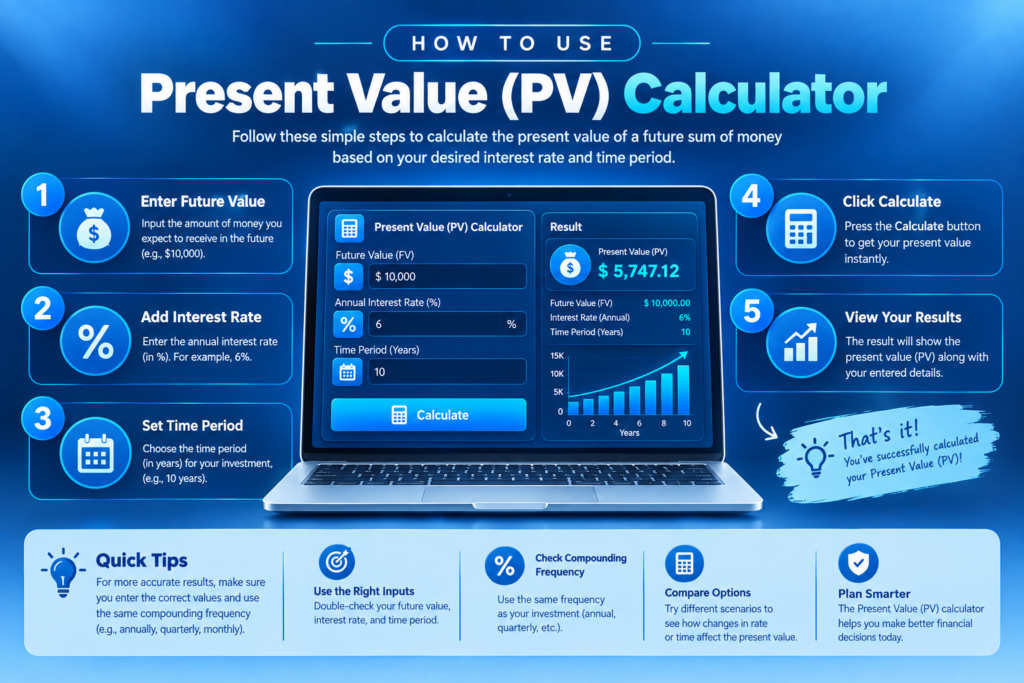
Getting an accurate result from this PV calculator takes less than a minute.
Enter your values
Input the future value you expect to receive, your discount (interest) rate, and the number of periods until that amount is received.
Click "Calculate"
The Present Value (PV) Calculator instantly discounts the future amount back to today’s terms.
Get your results
View your present value result along with the total discount applied over the time period.
Result Explanation
Understanding Your Present Value Result
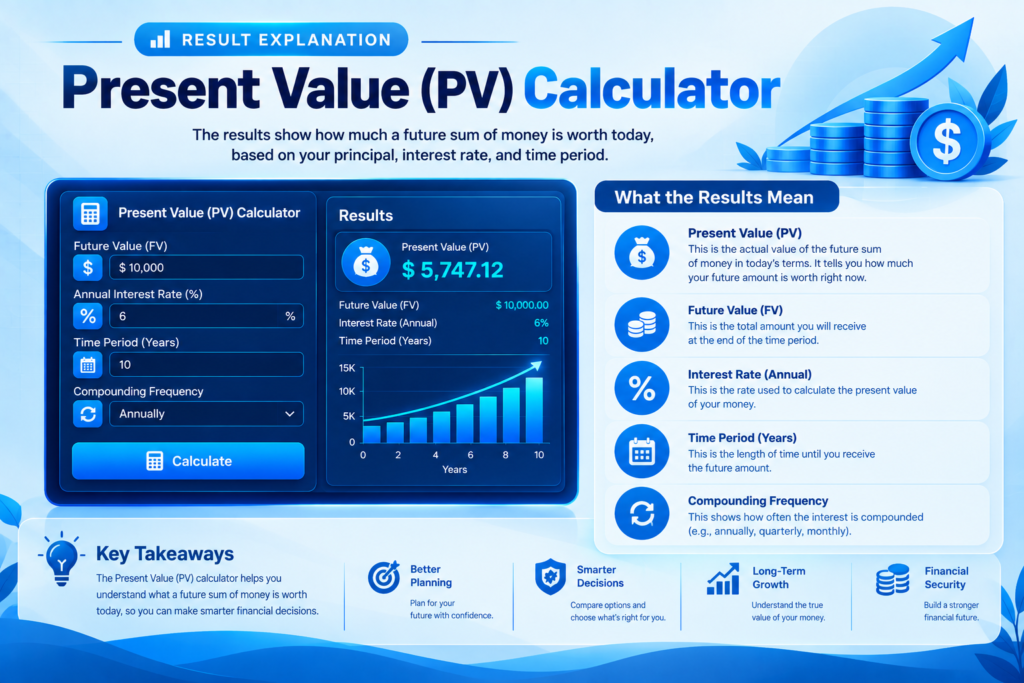
The number your present value calculator returns is the equivalent worth, in today’s money, of a sum you expect to receive (or pay) at a future date.
What the result means:
It shows you how much less that future money is worth right now, because money available today can earn interest and grow, while future money cannot.
Example:
If you’re promised $10,000 in 5 years and use a 6% discount rate, the calculator shows a present value of roughly $7,473 — meaning that future $10,000 is only “worth” about $7,473 today.
US/UK context:
In the US, this calculation is used heavily in retirement planning, bond pricing, and lease accounting; in the UK, the same present worth calculator logic applies to pension transfer valuations and lease-payment discounting under IFRS 16.
Formula / Method
The Formula Behind the Present Value Calculator
This tool uses the standard time-value-of-money formula behind every financial calculator present value function.
The core formula is:
PV = FV / (1 + r)^n
Where FV is the future amount, r is the discount rate per period, and n is the number of periods.
Symbol
Meaning
PV
Present Value — what the future sum is worth today
FV
Future Value — the amount to be received or paid later
r
Discount rate per period (annual rate ÷ compounding periods)
n
Total number of periods (years × compounding frequency)
Example calculation: If you expect $50,000 in 10 years and use an 8% annual discount rate, the present value comes out to approximately $23,160 — showing how much that future sum is really worth in today’s terms.
Who Uses This Calculator?
What Is a Present Value (PV) Calculator and Why It Matters
A Present Value (PV) Calculator is a financial tool that tells you what a future sum of money, or a series of future cash flows, is actually worth today.
It does this by applying a discount rate — a rate that reflects the time value of money, meaning a dollar today is worth more than a dollar tomorrow because today’s dollar can be invested and grow.
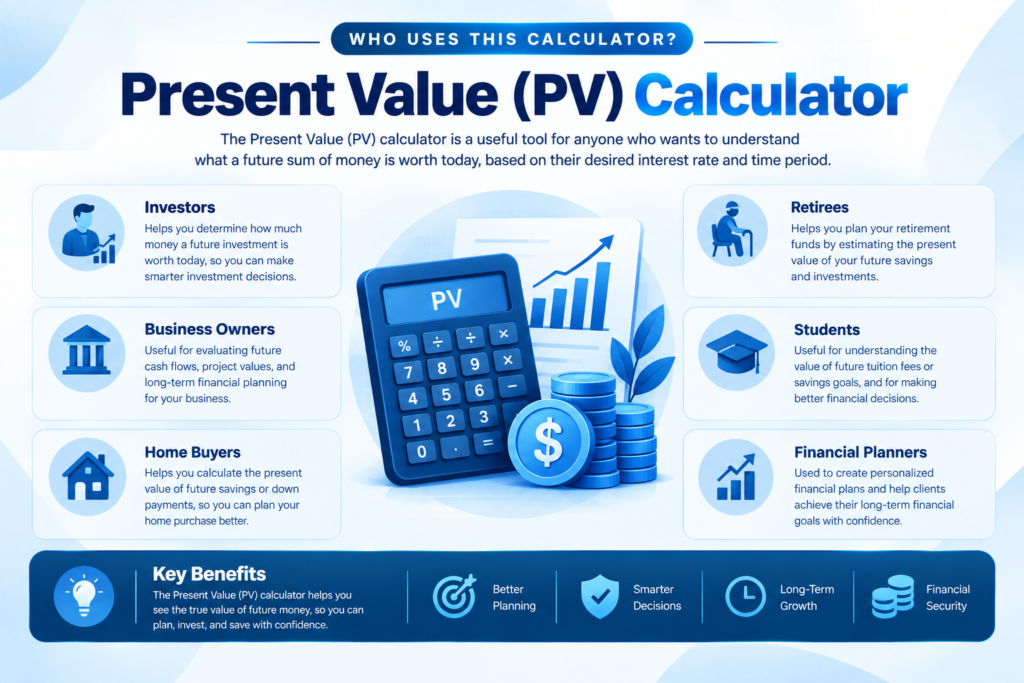
This PV calculator is one of the most widely used tools in corporate finance and personal financial planning across the US and UK. Investors, analysts, and everyday savers rely on it to compare offers, value future payments, and make smarter financial decisions.
The math behind this tool answers a simple but important question: “How much would I need today to end up with a certain amount in the future, given a specific rate of return?”
Instead of manually working through the discounting formula, the calculator instantly applies it and returns a precise present value figure.
In the US, this same logic drives bond pricing, retirement account projections, and lease valuation under GAAP accounting standards.
In the UK, the identical present value of money calculator logic is used for pension transfer value assessments and lease-payment discounting under IFRS 16 accounting rules.
Whether you call it a present worth calculator, a PV calc, or simply a discounting tool, the underlying math — and the decisions it supports — stays the same.
🌙 Zorvo Tools Feature — Built for Speed & Comfort Our Present Value (PV) Calculator runs on a modern, lightweight interface with a full Dark Mode option — easy on the eyes for late-night financial planning, and built for fast performance even on mobile connections. No bloated ads, no slow load times.
This tool is especially useful for comparing offers. Would you rather receive $8,000 today or $10,000 in 3 years?
Running both numbers through the calculator with your expected rate of return tells you exactly which option is worth more in today’s terms — turning an abstract choice into a clear, comparable number.
This makes the Present Value (PV) Calculator genuinely practical for retirement planning, lease negotiations, loan comparisons, and investment decisions — which is exactly why it’s built for repeat use, fast recalculation, and clean, exportable results.
🔗 Zorvo Tools Feature — Share This Tool Want to put this calculator on your own blog or website? Use the free HTML embed code at the top of this page to add the Present Value (PV) Calculator directly to your site in seconds.
For a deeper academic breakdown of the time-value-of-money principle behind this tool, see Investopedia’s guide to present value.
FAQ
Frequently Asked Questions About Present Value
The most helpful present value calculator page doesn’t just run numbers — it answers the questions people actually search for.
What does "present value" mean in finance?
Present value is the current worth of a future sum of money or stream of cash flows, given a specific discount rate.
How do I calculate present value manually?
Use the formula PV = FV / (1 + r)^n. Our Present Value (PV) Calculator automates this instantly.
What is the difference between present value and future value?
Present value discounts a future sum backward to today’s worth; future value compounds today’s money forward to a future date. They’re inverse calculations.
How do you calculate the present value of future cash flows?
Each future cash flow is discounted individually using the PV formula, and the results are added together to get the total present value.
What discount rate should I use?
The discount rate should reflect your required rate of return, cost of capital, or a comparable market interest rate — this varies depending on the context of your calculation.
Does compounding frequency affect present value?
Yes. More frequent compounding (monthly or daily vs. annual) changes the effective discount rate and slightly changes the present value result.
Can this calculator handle multiple future cash flows?
Yes — for a single future amount, use the basic present value calculation; for a series of cash flows (like lease payments), each one is discounted and summed.
Is this present value calculation accurate for real-world decisions?
It’s accurate for the assumptions you enter. Since real interest and discount rates change, many users test multiple rate scenarios rather than relying on a single number.
What's a realistic discount rate to use?
For US/UK contexts, many analysts use 5–10% for corporate finance decisions and lower rates (2–4%) for low-risk, near-term valuations — but your own rate should reflect your actual situation.
Is the Present Value (PV) Calculator free to use?
Yes, completely free, with no signup, no usage limits, and no hidden fees.
Disclaimer
Results from this Present Value (PV) Calculator are for informational and educational purposes only and do not constitute financial advice. Actual results depend on the accuracy of the discount rate and assumptions used. For personalized guidance, consult a licensed financial advisor. See our full Disclaimer Page for details.